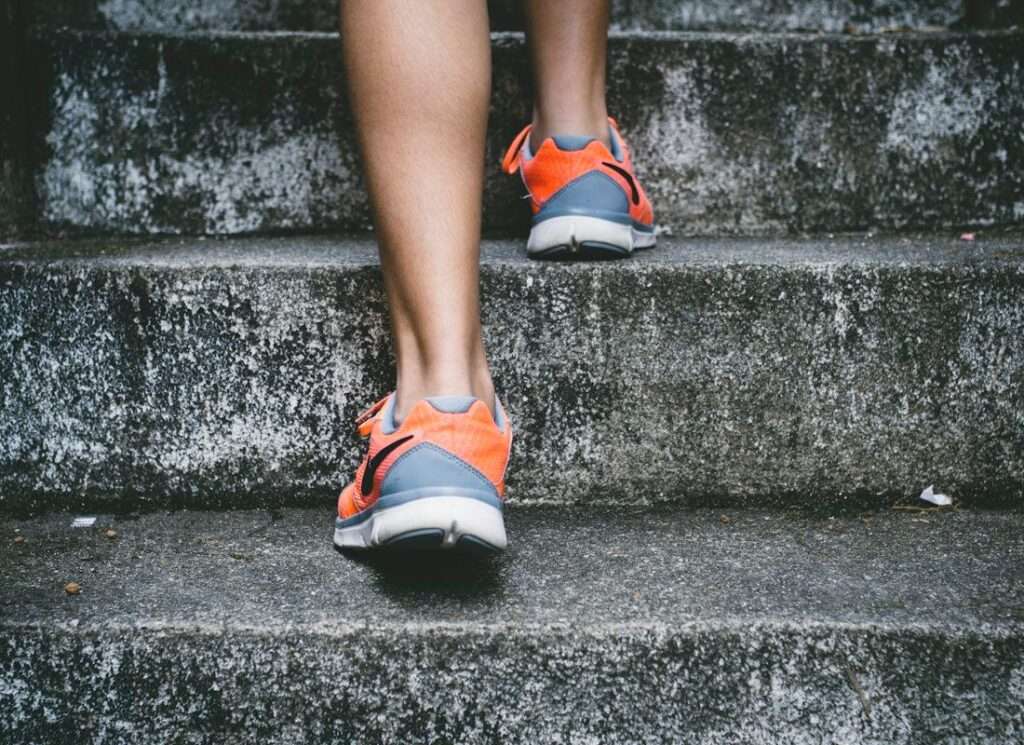
Flat ground is fine. But stairs, especially going down, make the front of your knee ache. Maybe it’s worse after sitting through a long meeting or a movie.
The short version
- Stair pain usually means your knee is taking load that your hips and thigh muscles should be sharing.
- Strengthening them, and gradually loading the knee itself, is one of the most reliable ways to calm it down.
Stairs load the knee more than walking
Going down stairs means controlling your bodyweight on a bent knee, one leg at a time. If your quads and hips aren’t strong enough to absorb that load, the joint and the tendon below the kneecap take the strain.
Where the hips come in
When the glutes are weak, the knee often drifts inward on each step. That changes how the kneecap tracks and adds stress to the front of the knee. Many people with knee pain actually have a hip strength problem.
Seeing how your knee moves on a step, a squat and a single-leg exercise tells me a lot. It’s one of the first things we test together. See how the $79 intro works →
What helps
- Strengthen the quads with exercises you can do pain-free, like wall sits, box squats or leg extensions.
- Strengthen the glutes and hips with bridges, side-lying leg raises and step-ups.
- Practise controlled step-downs from a low step, slowly, with the knee tracking over the toes.
- Don’t avoid stairs entirely. Total rest makes the knee weaker. Adjust the load instead.
Pain is a guide, not a stop sign
Mild discomfort (around 3 out of 10) that settles by the next day is usually okay while you build strength. Sharp pain, swelling, or pain that keeps getting worse needs a proper look.
A simple knee-friendly routine
Two or three times a week, try this:
- Wall sit: 3 holds of 20–45 seconds, at a depth that feels comfortable
- Glute bridge: 3 sets of 10–12
- Side-lying leg raise: 2–3 sets of 12–15 per side
- Slow step-downs from a low step: 2–3 sets of 6–8 per side
Start easy and build gradually. The goal is to finish feeling like you worked, not like you aggravated your knee.
What about running and hiking?
Vancouver’s trails and the Grouse Grind are hard on knees that aren’t strong enough for them. You don’t necessarily need to stop. Reduce the volume while you build strength, use poles on steep descents, and increase gradually again once stairs feel easy.
Common questions
Is knee pain on stairs a sign of arthritis?
Not necessarily. Many people with knee pain on stairs have no significant arthritis. Even when arthritis is present, strengthening the muscles around the knee is one of the most recommended treatments.
Should I use a knee brace?
A brace can help some people feel more confident in the short term, but it doesn’t replace building strength.
Do you work with people who have knee pain?
Yes. After checking that you’ve been cleared by a physio or doctor when needed, I build knee-friendly strength training in my downtown Vancouver studio.
Want to take the stairs without thinking about it?
Let’s find out what’s overloading your knees. A full movement assessment plus a coached session in my private downtown Vancouver studio. Two sessions, $79.
Questions first? Text me
This article is general education, not medical advice. If you have severe, worsening or unexplained pain, numbness, or pain after an injury, see your doctor or physiotherapist first.